Ending ‘streaming’ is only the first step to dismantling systemic racism in Ontario schools

This article highlights some of the noxious effects of streaming.

https://phys.org/news/2020-07-streaming-dismantling-racism-ontario-schools.html
Last week, the Ontario government announced its plan to end streaming in Grade 9, something Education Minister Stephen Lecce acknowledged is a “racist discriminatory” practice.

Streaming refers to the practice of placing students into educational programs—academic, “applied” and locally developed. These placements usually take place after Grade 8. They are often based on teacher and guidance counsellor recommendations. For Black students, low expectations and assumptions about their academic abilities and potential, direct them away from “academic” programs, which often lead to university.

Lecce promised to end the longstanding practice of streaming, which impacts Black, low-income and Indigenous students disproportionably. The province notes that students “enrolled in applied-lvel courses have multiple negative outcomes and limited opportunities for post-secondary advancement”..”

Four years ago, my colleagues Tana Turner, Rhonda George, Sam Tecle and I surveyed parents, community members, students and educators about Black student‘s education. Respondents revealed that the streaming of Black students into non-academic pathways was a major concern. After we completed our study, we published a report, recommending the elimination of streaming for the Greater Toronto Area.

Indeed, streaming is an essential component of the architectural structure of inequity and a significant scaffold in the system of racism and discrimination..

Will streaming actually end with Ontario’s bold actions?  “Will we see the fulfilment of Ontario Premier Doug Ford’s pledge to “ensure students from all walks of life are set up for lifelong success”?

Will the move lead to the equity education that Black parents and community members have long sought?

A racist, white supremacist structure

In addition to moving forward with ending Grade 6 streaming beginning fall 21021, the province also proposes eliminating “discretionary suspensions for students, strengthening sanctions for teachers who engage in behaviour of a racist nature and providing teachers with additional anti-racism and anti-discrimination training.”

But these changes require more than just a policy shift. They require a commitment to doing things differently. They require a major cultural shift in education with a critical examination of the policies that have structured school programs, practices, curriculum and pedagogy.

It is not only educators who must make this cultural shift but all members of the society; for streaming has been made possible through, and in relation to, the classist, racist, white supremacist structure that underlies the colonial education system we have inherited.

Teacher assumptions

The over-representation of Black students in lower-level schooling programs reflects teachers’ assumptions that these students do not have the capacity to succeed in an academic program of study. Students who take lower-level educational programs may graduate from high school, but they often have difficulty finding suitable employment and are likely to be trapped in precarious, low-wage jobs.

Furthermore, students are placed at about age 14. This means that students and their parents are asked to decide on an educational path at an early stage of a child’s social, emotional and educational development. At this stage, young people may have little idea of their educational, employment and career aspirations.

Streaming is disadvantageous to the educational and life trajectories of students – especially marginalised, Black and Indigenous students. .

Streaming has been made possible through classist, racist, white supremacist structures that underlie the colonial education system we have inherited.

Teacher expectations, testing, student records and the low educational performance of Black and other marginalized students have become normalized. As such, they sustain a schooling structure and a climate that affirm a system of inequity.

While formalized streaming takes place in Grade 9, it actually starts much earlier via the opportunities presented to students or the learning designations or labels applied to them that channel them into particular educational paths.

Black, Indigenous and other marginalized students are under-represented in enriched and gifted classes. This is usually justified by their “low performance” assessed by their low grades from teachers that are used as indicators of their academic abilities.

And insofar as teachers are well-socialized to prepare for and teach academic, applied and locally developed classes differently, how will they think of their new Grade 9 classrooms with what some researchers refer to as “mixed ability classes?”

Grade 8 teachers are accustomed to teaching such classes, so they might be able to provide useful curricular, teaching and learning insights to their high school colleagues.

Like some teachers, there are parents, students and others who believe that eliminating streaming will contribute to a “dumbing down” of the curriculum. They anticipate teachers teaching to the capacity of the lowest ability students and a situation in which “bright” students will be disadvantaged, for they will not receive education commensurate with their abilities and skills.

A first step

Will teachers be able to separate students’ potential from their race and class positions?

The Ontario government’s “bold action” is an essential first step. Still, it must be accompanied by a recognition of how Canadian white supremacist culture contributes to a construct of students’ abilities and knowledge based on their race.

If we do not address the cultural norms and values of society, which inform educational institutions, we will continue to have streaming in many other forms and guises.

In other words, in the absence of real anti-racism education and measures, streaming will still occur in many different forms—only now unofficially. Policies, programs and curricula must be assessed for the ways they maintain systemic racism and inequity and maintain the ways in which racism impacts students.

Sorting machines

Education researchers Thurston Domina, Andrew Penner and Emily Penner argue that schools are “sorting machines” of inequality. They say, “schools are egalitarian institutions that produce social inequality”.”

Schools create social categories and have processes that sort students—on the basis of race, gender, class and other identities—into social hierarchies that “facilitate the creation of further inequalities both within schools and in the adult world.”

Essentially, schools are instrumental to our neoliberal capitalist system, and as such play a vital role in maintaining it even as we protest systemic racism and anti-Black racism.

What will it take to change things?

Charlotte Nordmann

Charlotte Nordmann is an essayist, translator and teacher of philosophy.

A manifesto for democratic schools: it is time to exit from the impotence and infantilisation brought about by the republican school and the siren’s song of reaction.  There is a need for a system to bring about autonomy and emancipation. 

The nature of the “republican school” is the fundamental problem.  Since its foundation it has contained an irreducible contradiction; in effect its function is two fold, one hand it is democratisation, on the other it is hierarchisation. 

These contradictory principles can be seen to originate in the ideology of work; of merit and its recompense.  The hierarchies produced by schools are founded on the ascent of the best, that is to say, “the most worthy”. 

Today, having given up on equality, we say that school must provide “equality of opportunity”.  That at least ensures that all have the same chances from the start, from then on it is up to the individual to prove their worth and to obtain the means for their promotion. This has always been tenable with difficulty if we look at the situation with a real concern for democracy; today it has become unsupportable. The section of children coming from less favoured backgrounds having access to the “Grandes Écoles” was negligible in the 1960s, today that figure has decreased at a time when there is mass unemployment and precarious work has become common, so how can this culture of work and merit be of any use. 

Phrases like “we must “restore authority”, “there must be respect for the teacher” or “the inherent value of work” are trotted out, indicating that this discourse has no hold on the clamorous and omnipresent realities. 

This because all of that has been lost, has been devalued and trampled underfoot by oblivious profiteers who are oblivious as to where we are now. 

The grave of a really democratic school was dug in May 1968.  It was democratic in the full sense of the term as its demands were equal for everybody.  It gave the children, amongst them the most meritorious for sure, the means to rejoin the ranks of their superiors… men of whom their country would be proud. 

The partiality of the principles of selection has undermined the foundations of our democracy. The school no longer functions as a social elevator (How many places in the lift?) because it has ceased defending its fundamental principles, work, effort, merit, again and especially respect. A truce of evasions; now everyone knows that they are responsible for their destiny and that sociology was only created to provide the wretched with excuses – like the fiction that liberty was only created, in Nietzsche’s words, to be able to punish. 

Can you imagine a more useless argument?

There are sad arguments out there, look at the desperate individuals foreseeing their powerlessness, regretting the failure heralded by the campaign against the flow of a time where the verdict has already been decided beforehand, of an era unworthy of the description “democratic” that has become the standard bearer of vulgarity and mediocrity. 

Can you imagine a more shameful discourse than one that makes those who “can’t get up early” guilty and accusing them of being responsible for their sufferings. 

Besides, what could they do if they got up early, what work could they do?  These are precisely the questions that are forbidden by the return of anachronistic discussions. 

It’s all about the death of democratic hope, the social promotion is allowed to certain individuals, hoping to save some, in global contempt those of whose social origin is questionable. 

It’s about learning to recognise that the existing social order is the only possible one, accepting its principles and limits and, above all, submitting oneself to it, then defending and respecting it. 

Is the ideal of a “good student” an even more fundamental point; of the “serious pupil really desirable?  The reverence and submission that this position so often implies, the dependence upon the teacher and the undervaluing are all problematic. 

The word that best describes the problems produced by the current system is “impotence”.  The impotence of the pupils, dispossessed of any autonomous relationship with knowledge, writing and language.

The impotence of the teachers continually forced to make assessments and dispossessed of any means of making the machine function better, ceaselessly feeling a sense of persistent absurdity. 

The impotence of parents, who want a lot from school, but without understanding why it is incapable of fulfilling its promises. 

School inculcates “That’s the way that school is and it won’t be any other way” and one has to go with it.  One might say, “First and foremost, pass the exams”.  In principle one has to follow this route because it is not permitted to make your own way. 

They talk to us about “Democracy at school”, but what control do the pupils have over their courses and how they are organised?

The principles of “Institutional Pedagogy” allow us to bring some concrete responses to these problems. If democratic politics were to be employed then one of the barriers that would be removed would be that of the school; an alternative school is possible. 

Today, the contradiction that seems to be aggravated, with measures such as allowing a free choice of schools and the obligation of teachers trained in one discipline to teach two, is the tendency to accentuate the hierarchy between schools, whilst rejecting the universal access to knowledge and the mastery of the essential abilities needed for autonomous intellectual activities. 

We hope that this untenable situation for everyone who attends whatever type of school will arouse the desire to change things. 

For an alternative to exist or for schools to function in a different way, it is essential not to think that it is purely a problem of pedagogy. The outcomes do not depend solely on the methods used, out the values embodied.  The syllabic method or the global approach do not have all the powers ascribed to them, they do not produce rigorous and analytical attitudes, free spirits or subjugated individuals.  

Neither is it necessary to focus on the means or the financial investment in schools. To start with, the idea that the weak uncertain mind should be guided by a competent educated individual needs challenging.

It is necessary to talk about the organisation, the material and human circumstances that bring about success for everyone. Here Freinet and “Institutional Pedagogy” suggest concrete measures to exit from the teacher-pupil situation brought about by the “school machine” which is only a motor for narcissism or pupil anxiety or the need to “please the teacher”.

There is an urgent need to politicise the question, not only in terms of the “endlessly reductive” and the resistance to the marketisation of education, as important as they are; it is necessary not to avoid the inherent contradiction in the logic of the school, in order to find the means to highlight its emancipatory role against its function of creating a hierarchy. 

The political issues around the acquisition of reading and writing skills, the relationships with language and knowledge need re-examining. 

How can we encourage autonomy?

How can the reliance upon the “educated” and “experts” in the transmission of knowledge be questioned?  

To democratise teaching could mean putting it within the grasp of a new public, by simplifying the content and reducing it to its basic elements. This commendable approach ignores many important aspects of knowledge, including those that are constructed historically and the arguments about it that arise from a political background. 

It is necessary to examine our own relationships with language and knowledge in our search for our own autonomy. We need to break out of this infantilising circle in order to think about and to want other possibilities. 

In this undeniably difficult situation it is necessary to exit from the anxiety that paralyses us, to see the effect of maintaining the status quo which would ruin all that we would wish to defend and to renounce all desirable aims.  It is anything but naïve to affirm that it is necessary to restore confidence in our ability to act and to cultivate the desire for true democracy.

Philippe Meirieu

Philippe Meirieu is professor of Education at Lumiere-Lyon University.

“Pedagogy is a tool for today’s challenges. Pedagogical inventions help us to resolve everyday problems, like punishing without excluding, living together and not leaving any child by the wayside”. 

Pedagogism has become columnists new scapegoat; pedagogy and its history have never been so misunderstood.  However, the contributions of pedagogical opinion may be helpful in thinking about and trying to overcome the difficulties in which we find ourselves today. Important topics like dealing with school rejection, the difficulties in accessing formal knowledge, the organisation of rituals to focus attention, the place of experimental approaches, research into learning, taking into account the body and physical activities, the tension between constraint and liberty, the possibility of punishing without excluding, learning to live together and plenty of other questions besides need treating in a profound way.

We must certainly be careful in looking for ready-made solutions to today’s problems in various pedagogical doctrines. 

On the other hand, it is interesting to try and understand the reasons behind the approaches of those pedagogues. In many ways they anticipated our current project of “not leaving any child by the wayside”, which is a fundamental right.  Before today they have been confronted by the same contradictions that we are now encountering; such as kindling a desire to learn when faced with an imposed curriculum. How can we transmit knowledge and develop a critical outlook?  How can we deal with specific problems without stigmatising or making the child ill?

From Pestalozzi to Oury, pedagogues have explored that fundamental contradiction between two ideas that are both necessary whilst appearing contradictory: the concept of “educability” indicates that all individuals are able to learn, whilst that of “freedom” says “no one should be forced to learn”. 

In renouncing the first idea, we allow “educational Darwinism”, fatalism and selection by failure to win. If we reject the second, conditioning and training threaten. On the other hand, keeping them together opens a considerable space for our inventiveness. A space that has been occupied by people who attempt to teach those on the fringes of society and who have developed approaches to democratise education. 

The history of pedagogy also contains a remarkable reservoir of antidotes to facile and doctrinaire thinking. The pedagogue is a worrier, not through weakness or lack of reference points, but because he insists in facing up to difficult realities. Also because he doesn’t wish to renounce the desire to teach, but doesn’t want to teach in a clinical way. 

Albert Thierry (1881-1915) was faced with young peasants who were as reluctant to study as some modern youths.  He recounted, “I saw Marcel Brun suffering under my control as if he was faced with a red-hot iron”.  Whilst remaining intellectually demanding, in that strange situation he saw that the pupil could not function. There was no question about it that he had to moderate his objectives to deal with the pupil’s resistance to learning; that to him was pedagogy. 

“Real pedagogues do not agree with spontaneous libertarianism. Fernand Oury denounced the idealists who kneeled before the “Petit Emile with a pink bottom”, who allowed the children to do what they wanted with law or rules. He also denounced the use of the cane saying “One pays severely for brutal repression or for the naivety of laissez-faire. It is difficult to recover that which is lost in constraining them without sacrificing the development of liberty through new types of group work”. 

He was influenced by Makarenko (1888-1939) and Korczak (1878-1942) both of whom were devotees of the collective construction of rules which allowed them to escape from the “law of the jungle” or rules imposed by little chiefs. 

The teacher did not make the law, he embodied it.  He was responsible for the fundamental rights in forbidding the incest, harm and gratuitous acts, to ensure a satisfactory future and freedom.  That prohibition actually authorises… even if it isn’t easy to comprehend, even if it isn’t immediate and even though it brings frustrations.  The pedagogue believes that the child must accept these frustrations if it is to perceive and to design the programme whose outline it is helping to draw. 

However to “perceive” and to “design” are not the same thing; in the first case the child or pupil has to claim ownership of the adult’s question, in the second he is its author, or at least its co-author. 

One of the issues highlighted by pedagogical reflection is the multiple interpretations of “interest”.  Is that the “child’s interests” or that “which interests the child” or is “in his interest”.  Dewey (1859-1952) and Decroly (1871-1932) tried to show this can be resolved not by opposing the “immediate interest” (superficial) and “profound interest” (cultural), but by inventing some original propositions that are found in not Psychology, nor in the curriculum.  “Project pedagogy” has object of devising and putting into practice. 

Pedagogues are not disinterested in the fundamental question about the formalisation of knowledge. Insisting in the discovery does not mean that they minimise its systemisation;  Comenius (1592) and Freinet (1896-1966) are not incompatible. The former considered that progressiveness and exhaustiveness in learning are the key to accessing all knowledge, whilst the latter made experimental trial and error the cornerstone of his method. In addition, Comenius never stopped affirming the importance of “finding out for oneself” and Freinet, who invented coloured belts and a system of diplomas, insisting on working to organise knowledge. 

If one tries to look at them deeply, the pedagogues inform us about educational facts.  Certainly, one has to deal with the irritation of vague or excessively polemical arguments. On can certainly think that Freinet exaggerates when he says that in schools the national flag should be replaced by Dante’s inscription on the gates of Hell, “Abandon hope all he who enter here”.  On the other hand, should we ignore his immense and minutious work. 

In the same way, we may be irritated by some of the scientific pretensions, say of Maria Montessori in her books “Scientific Pedagogy” and “The Absorbent Spirit”.  This is not a psychological concept, but it is a useful tool for thinking about the attention of a class.

Similarly, working in groups may appear rather naive if one follows the injunctions of Cousinet, but it is particularly interesting if one sees it as a way of getting the pupils to participate socially.  

In reality, nothing is more current than pedagogy; on the fringes of institutional and philosophical systems, it develops alternative ideas, opens new pathways, suggests alternatives to escape from the eternal contradictions between nature and culture, innate and learned, authority and liberty, taking into account the need for order, whilst allowing for change, etc. 

Faced with a world where individualisation appears to be an irreversible movement, whilst at the same time there is a great need to (re)construct a collective sense.  Perhaps it is possible to find a way through by examining pedagogy. 

Philippe Meirieu is a Professor at the University of Lyon II. He is the author of many articles and book.  He has been involved in workshops and reforms.  His “Pedagogy, the Duty to Resist” was published in 2007

Talking about grammar is a crucial tool in literacy teaching, study shows

This research appears to echo Nancy Martin’s 1976 “Writing and Learning across the Curriculum” – “plus ça change….” That in itself makes it worth repeating

Child reading

Discussion between teachers and children about writing is a crucial tool to help pupils learn about grammar, a new study shows.

Academics have found “metatalk” can enhance understanding of writing and boost children‘s confidence during writing lessons.

But for this to be effective this needs to be in the form of a dialog with pupils, to open up children’s capacity to make and discuss their linguistic choices and allow them to reflect and put forward their own views.

The research found that some teachers miss opportunities to use discussion to reinforce literacy teaching and children’s understanding, instead relying on “hollow” praise.

Academics from the University of Exeter, who carried out the research, found not all teachers take the opportunity to extend their talk. In some cases the teacher’s response to children’s questions and answers missed the chance to redirect them to a more focused and meaningful level of thinking.

Researchers witnessed some teachers speaking to children in the form of a monolog, in a “closed” way where they were just making statements. They only sought simple responses from children rather than a discussion. Some teachers gave incorrect explanations about grammar during discussions, and sometimes closed down discussion when they seemed less secure about their knowledge.

Some teachers concluded their discussion with an affirming, positive statement such as “brilliant” or “fab” or just saying something about the child’s writing they liked without saying why. This praise could appear blind or hollow, because it did not make clear what it is that is being praised.

Ruth Newman, a member of the research team, said: “talk is important to literacy teaching, but teachers can occasionally miss the opportunity to use it as a tool to enhance understanding. Talk is crucial for developing writing.”

“Our message for teachers is to see these missed opportunities as growth points, as something to be developed. Learning about writing doesn’t need to take place in silence. Talk helps children to think about the choices they make.”

However the academics also witnessed teachers speaking in a “dialogic way,” where they engaged in a two-way discussion about the relationship between grammatical choice and intended rhetorical effect. These teachers opened up talk about language, inviting students to explain and justify their thinking. This kind of talk enabled students to make purposeful connections between grammatical choice and its effect

Academics worked with 17 classes of 10 and 11 year olds, in the final year of their primary education. Their teachers attended three professional development days to develop understanding of and confidence with the pedagogical principles of grammar as choice. They then taught two units of work developed by the research team: one focused on fictional narrative writing, and the other on persuasive argument.

Teachers were conscious that the final pieces of writing would form part of the teacher-assessed writing mark, so interrupted purposeful sequences of learning with instructions about grammatical features that should be included in the writing. The looming presence of the national grammar test for this age group meant teachers used discussion as an opportunity to check grammar knowledge, and this diverted lessons away from exploring grammar-meaning relationships.

Professor Debra Myhill, who led the study, said: “There are many teachers who do open up useful discussions about writing or grammar in the classroom, but some only start closed discussions, and miss opportunities to build learning through allowing children to give more extended responses. The best discussions about grammatical choice in writing helped children to extend their own thinking, enabling higher-level learning, and greater collaborative participation across the class.”

Grammar teaching leaves children confused, research shows

Children can be left confused and unable to write accurate sentences because of “uncertain” grammar teaching, experts have warned. But confident teachers can enable students to use their grammar knowledge to help them craft and create their writing and positively support children’s development as writers. Teachers concentrate on making sure primary-aged pupils can remember and repeat simple explanations—such as “a verb is a doing word; an adjective is a describing word—during grammar lessons rather than helping them understand key ideas. This hinders their learning and leaves some pupils only able to repeat these definitions rather than understanding what they mean.

A new study highlights how these activities often have no other purpose other than to provide evidence for national testing, yet children don’t often understand the feedback they are given about their writing produced for this purpose.

Experts from the University of Exeter have called for teachers to be given more support to stop grammar teaching becoming an “abstract and exotic” part of the curriculum and help them make it a natural part of lessons.

Academics working on the Economic and Social Research Council-funded project, called Writing Conversations, set out to explore in depth the relationship between children’s grammatical knowledge and their development as writers, as well as the impact of grammar teaching on children’s learning and writing. They tracked all the pupils in two primary classes and two secondary classes, each in four different schools in Devon, over three years. They spent time in school talking to children about their understanding of grammar and about their writing to analyse the relationship between what the children had been taught and what they had learned. Where teachers addressed the grammatical concept carefully, and then linked the grammar structure to what it does in a text, children were much better able to use grammar knowledge to make effective choices as writers.

The new National Curriculum, introduced in 2014, has an increased emphasis on grammar. Children in their last year of primary school now also have to take the Spelling, Grammar and Punctuation test. But teachers are given different messages about why children should learn grammar. They are told it is to help children learn how to accurately structure sentences, but also that it is to help them make effective language choices in their writing.

Researchers found children are now more confident in identifying grammatical structures since changes to the curriculum, but this is often knowledge learnt for tests or teacher assessments and children find it harder to describe how these structures affect their writing.

Dr. Helen Lines, one of the researchers on the project, said: “Our study shows if teachers explain grammar in a more practical and natural way regularly, other than something separate or abstract from other lessons, children will better understand.

“Over-focusing on labelling and identifying grammatical terms is not helpful and the Government and teachers need to think again about how children can gain a more sophisticated and enriched understanding of what grammar is. They need more space in the curriculum for children to express both their understandings and their confusions.” Professor Debra Myhill, who led the project, said: “Children’s writing does become more sophisticated as they become older, but very often they can use a particular grammatical structure in their writing before they can describe what they have done. We don’t yet know if this is developmental, or linked to how students are taught. But what is clear is that teachers who themselves are comfortable with grammar are better able to handle children’s confusions and help them become more thoughtful writers.” 

Fernand Oury

Fernand Oury

Fernand Oury (1920-1998) was a teacher in the Paris suburb of La Garenne- Colombes, at the same school where he had been a pupil. He was close to Francoise Dolto, Jacques Lacan, Felix Guettari and his brother Jean Oury, who founded the psychotherapy clinic of La Borde. 

Along with George Lapassade, Francois Maspero and Aida Vasquez, he developed the concept of “Institutional Pedagogy” which transformed the teacher-learners’ relationship.  It emphasised how self-governing group dynamics among learners facilitates learning in general and access to critical thinking in particular.

He supported the concept of heterogeneity, simply because children do not grow and develop at the same pace, he put into practice the techniques of Freinet, which he enriched with his own experiences.  He adapted the judo principle of grades with coloured belts allowing him to orchestrate the differences in level for the benefit of all. 

Traditional pedagogy assumes a homogenous audience; the controlled work assumes identical individuals who regularly progress at the same pace. The general discipline assumes a homogeneous mass without dregs.  Fortunately, that homogeneous class only exists in the minds of pedagogues and politicians. 

Everyone knows the reality; though equal in law, children are all different and, in class, the “strong” are called “good and acceptable”, the “weak” are described as “bad, unacceptable, discontented, feeble, disturbed or misfits. 

Important people love playing God; “sorting the sheep from the goats”.  They define the criteria for selection, they orientate, they reform, they restructure and they have fun. They go on to label classes as rubbish and schools as dumps. At the expected level or not, it’s always about classes that they wish were homogeneous. 

We are not alone in thinking that school is “made to measure”. Each pupil works at the set pace and level, each for himself. Sometimes it’s like being locked in a teaching machine.  What happened to communication, collective working, the dynamism of groups and teams?  

The criticism of this approach dates back more than half a century, with some seeing alternatives, providing individualised work. The heterogeneous class that we have is split up and organises itself in a system of tiny more homogeneous classes for reading, French, calculations, problem solving and writing. 

“In practice, evaluating the pupils abilities isn’t difficult, I give them a photocopied sheet containing, for example, 25 problems graduated from introductory to middle school levels.  They do what they can and then they stop. 

Alternatively, I dictate 25 words or phrases and they understand, if they can finish the activity, they won’t have to do the elementary course. We talk about scores, not marks and we can see the “level’ in the same way as we see the temperature.  

At no time is there a global comparison.  Why do that?  Even if they aren’t particularly successful, they know that cheating would be ridiculous?  Someone at the basic level would certainly not want to be classed above that because the next level would be above their competence and they risk suffering. 

It is the score obtained that determines the course and the colour. The results table, which has no scientific pretensions, is a tool that enables us to create more homogeneous groups. 

We all need manageable classes. The colour coding based on the idea of judo belts allows individuals to see where they are in each subject.  One pupil may be green in reading, orange in French, blue in arithmetic and green in reading. The results table and the colour code provide all the details for the group. The pupils’ colours can change; there are no barriers. 

No one, not a baby, a toddler, an adult or a sick person, will react in the same way to the demands.  From a grownup we expect more than a little one. Everyone knows it, everyone does it and if it isn’t said, everyone risks running into the juvenile desire for egalitarian justice. “It isn’t fair; he can do it and I can’t. Why not”?

This legitimate question “is he higher (or lower) than you”, is answered by the results table,

As with Judo, like everywhere, the demand becomes an honour, an indication that the others hold you in esteem. In the elementary course where the normal pupil will be 8 or 9 years old, there are four levels; yellow for a student who performs and is considered as an infant of 6 years. Orange corresponds to 8 years of age, green to 10 years and blue to 12 years. 

The better one performs, the more the right and duties increase; but, one the other hand, infantile behaviour is less and less tolerated. Regression remains a possibility, but the word is never used. It is useful to know that levels of behaviour are not necessarily tied to scholastic levels. 

Certainly, each new school year, it is me who assigns the levels, if Antoine doesn’t agree, we talk about it in the council. 

A Voyage into the Heart of Institutional Pedagogy

In 1973, the three young founders of La Neuville School, Michel Amran, Fabienne d’Ortoli and Pascal Lemaitre wanted to develop their pupils’ well-being. They were influenced by the pedagogue Fernand Oury and the psychoanalyst Francoise Dolto. Within a framework of coloured belts, the youngsters build their learning with adult assistance. 

The teacher announces, “We need someone to act as a guide”. 

Zachee from the “Corner Group”, volunteers without too many regrets, dragging himself away from the maths problem that absorbed him earlier, in order to accompany the Parisian journalist.  He has the responsibility of revealing the ins and outs of this unique boarding school. 

The estate consists of a chateau and its surroundings near Longueville (Seine et Marne).  The visit commences with the “Staircase Class”, where the youngest children are taught. Max-Adam, the school’s youngest pupil bluntly explains, “Here we learn to read and write.  We have some work to do and we get paid”. 

Zoheir (12 years) completes the explanation, “Each group works at its own level of difficulty. The Eleven Steps and Corner Groups know more stuff.  To get there is a bit like judo, you have to gain the next belt.  Me, I’m an orange belt in reading and writing, but only dark yellow in grammar”. The darkest belt is brown. “Here the students progress at their own pace. Everyone helps everyone else and tries to understand their way of working,”.

Zoheir is voluble, “Here, we are in the country. We look after the animals.  We’re in a calm place, where we can talk to people and people help us. Like in outside, you can earn money by working. The jobs include changing the date every day, giving out rulers, issuing exercise books and emptying the waste-paper bins.  Me, I look after birthdays, today it’s our teacher’s birthday.  This evening there is a dance, that’s for relaxation”. 

At lunchtime the children responsible for the meal busy themselves in the refectory.  Meanwhile, there are two different meetings taking place, one for the boys, the other for girls.  Under the guidance of an adult of the same sex, they can debate everyday problems, particularly the problem of managing conflicts between individuals.  The main weekly meeting on Thursday evening will be the occasion of a great outpouring in the direction of a student president, who is at least a blue belt.  The forty pupils and ten adults, who constitute the body of La Neuville, deal with the propositions and all the decisions will be written up in the “Book of Words” throughout the week. 

Michel Amran explained, “When we went to see Fernand Oury for advice, he immediately warned us not to make a new Summerhill, he feared, that in the course of 1968 we would align ourselves with the movement advocating no directivity like that self-managing school. After we reassured him, he gave us his support and directed us to Francoise Dolto. 

Fortified by this warning, the trio founded the school, where they struggled for the first few years, but they got by with children whose parents want an alternative education for them. Francoise Dolto sent them children who were undergoing psychoanalysis.  It was necessary to adapt, but Dolto was convinced that there would be reciprocal benefits for children who were progressing normally and those who were in temporary difficulty. “Where normality is in force, everyone hides their weaknesses, becoming ashamed of them”.

“In the presence of disturbed children, the mask drops and one can let go to become the person that one really is, with all the strengths and weaknesses, with fear of being judged. Thus began the processes of mutual aid and exchange”. 

There would be cross-pollination in the heterogeneous society that lies at the heart of La Neuville Project; an important part coming from the social support. 

Undisciplined, sometimes violent children, who are often stuck academically, little by little develop some autonomy and adapt to the rules of life that they themselves help to define. 

The visit reaches its end, the garden, the boys’ and girls’ dormitories, the swimming pool, the gym with its new judo mats and the tuck shop where the kids can spend the earnings from their jobs. 

In the Angle Group, Zachee philosophises as he waits calmly for the results an entrance test to the self-managed lycée in Paris; “It’s nice here, there’s swallows in summer”.

Private school education may damage students’ social and emotional development, study suggests

Privately educated students are more likely to experience bullying, start drinking earlier and take more risks than their state school counterparts, a new study has found. The study, led by the University of York, looked at whether going to private school benefitted young people’s emotional and social development, once family background and prior educational achievement had been taken into account. The researchers found that attending a private school was of little benefit and actually had a negative impact on some aspects of development.  While private school children are less likely to have behavioral problems, the study found they are 15% more likely to experience bullying over course of secondary school education; 24% more likely to take risks, and are younger when they have their first alcoholic drink, than students attending state schools.

Educational resources

In the UK, seven percent of secondary school children are privately educated. In 2019, tuition fees cost an average of £18,000 per year for day students or £35,000 for boarders. In the same year, the median household income in the UK was £28,400.

Lead author of the study, Professor Sophie von Stumm, from the Department of Education at the University of York, said: “Private schools expend greater educational resources than state schools for their pupils, including higher-qualified teachers and better pastoral care. Because of this difference in support, we expected much more positive outcomes for private school students—we thought that they would exceed their state-school peers in areas such as volunteering, practicing safe sex and self-control, which require being considerate of others and the consequences of actions.

“In fact we found little difference between private and state school students in these areas and when it came to bullying, risk taking and early consumption of alcohol, private school students fared worse.

“Our study adds to a growing body of evidence that many of the alleged benefits boasted by private schools are actually a product of their selective intake of students rather than the value that the schools add.

“Parents naturally want the best for their children, but for those who would struggle with the astronomical fees, our message is not to feel guilty—private school is not a necessity.”

Wellbeing across adolescence

The study looked at data from 2,682 individuals who took part in a large cohort study—2,413 attended state schools and 269 attended private schools.

The researchers analyzed data on family background and prior educational achievements as well as information gathered from questionnaires (conducted with participants between the ages of 12 and 21) on factors including wellbeing, peer victimization, sexual behavior, substance use and anti-social behavior.

The findings of the study suggest that, when it comes to overall wellbeing across adolescence, private and state school students do not differ. 

Privileged family background

Professor von Stumm added: “In the wider population we often assume that a private education will have a very positive impact on a child’s development. Our study suggests we have unrealistic expectations of the virtues of a private education, when in reality many of its benefits result from the legacy of a privileged family background.

“Interrogating the role of private schools in Britain is important because we live in a country where the majority of leaders in politics, business and in the arts were privately educated.”

Fernand Deligny (1913-1996)

Deligny was born at Bergues (Nord), he was a specialist primary teacher, then an educator who opposed the teaching methods of the Vichy Government.  From 1947 to 1962 he was Head of “Le Grande Cordèe” which attempted to rehabilitate young offenders.  This was supported by movements for popular education. 

In 1968 he founded a centre in the Cèvennes for autistic children.

He is the author of some memorable publications, including “The camera, a teaching tool” and the coauthor of films made with autistic children. 

He was the poet pedagogue who wanted to help the delinquents, the homeless and the psychotic, not to love them. 

When the law changed in 1945, the activities of Fernand Deligny were an act of pedagogical resistance. His “poetic pedagogy” is unclassifiable, indefinable and unrecoverable. 

Deligny was a teacher, educator, writer, film maker and a militant. He was influenced by the philosophy of Gilles Deleuze and Felix Guattari, he moved the boundaries, shook the framework and subverted the constraints of the established order.  The way he helped the lower class children to teach themselves, the homeless to escape from their problem, the autistic to find dignity outside closed centres and create art works is now largely ignored. 

Everything started at the lunatic asylum in Armentieres, situated between Lille and Bergues, where he was born.  There, he discovered the problems and life of the mentally incapacitated. He was a specialist teacher greatly influenced by Freinet’s approach.  He found himself as the main teacher in what was effectively a dumping ground for hundreds of abnormal children, who awaited their return to normal life. 

In “Pavilion 3” (1944), he wrote about his fascinating experiences in this world where they concentrated on the loss of reason suffered by the survivors and human wreckage of the Second World War. 

Deligny was not opposed to psychiatry, but searched for other ways to deal with these problems. 

In this grey barracks of a building, he pushed the hierarchy to ban arbitrary punishment.  In “Belief and Fear” (1978) he recalled, “I loved the asylum.  Take my words as you will, but I loved it because it was strong, just like most people love someone with whom they decide to spend their life”.

“The speech marks that one puts around the word “educator” are like a pair of forceps.  I don’t want to educate anyone.  My intention is to create favourable circumstances for them to survive and live”.

After the war, when his name was already well known, he resisted the politics of safeguarding children introduced by the Vichy Government, so when the 1945 law recommended the re-education and protection of delinquent children, the phrases of his book “Delinquents’ Potential” were widely echoed amongst social workers. 

His outlook was Marxist and Libertarian opposing, “A nation which tolerates slums, open sewers, overpopulated classes and dares to punish young delinquents.

With the aid of the psychobiologist Henri Wallon, who was a member of the Communist Party, and from popular education movements, he founded La Grande Cordèe, an association to take care of and cure delinquent and disturbed children.  This enterprise to reinsert them into society was more of a network of placements for those with lost childhoods than a centre. 

Deligny was never content just to save them, he never stopped searching for new ways to help them. He wasn’t an Abbé Pierre of the playground, nor a Don Bosco of social centres, “All effort not supported by research and rebellion soon becomes stagnant.  What we want for these kids is for them to learn to live, not to die.  To help them, not to love them” (“The Effective Vagabonds 1947). 

In spite of everything, Deligny struggled with difficulties regarding support and finance and he found himself in the wake of these problems.  

“The children have ears” (1948) , a series of stories where people are bundles, or an old slipper or a wooden bench, shows how a story imagined together can make things come alive and creates a state of emotional collaboration with children with whom direct exposure to friendship and camaraderie may frighten them away. 

This dream marked Deligny’s brief affinity with modern progressive education. He usually kept his distance from, what Jean-Francois Moreau calls, “The ideologies of childhood”.  That is those humanistic concepts of the child which result in the shaming of adults and parents. Beside which Deligny had no pedagogy, his was an active practice that evaded the institutional constraints. Later he was saddened by the changes in popular education that emptied it of its political and poetic power. 

He explored the camera, which was then a new educational tool.  Faced with the images that invade the screen and the spirit, he discovered the film as a language; an idea that pervaded his writings. Rather than creating cinema-goers, he allowed those misfits to use the camera in order to rediscover and form their lives, whilst discovering the world around them. 

He produced the film “The Slightest Movement” with Jean-Pierre Daniel, the director of the Alhambra in Marseille, a national artistic and cultural centre.  This was to test what could be done with such a cinematic concept. He was part of the adventure with a group of children on the île de Porquerolles.  One of them discovered a cork oak and developed a bug for that “soft tree”. Deligny and Daniel filmed that child’s affectionate relationship with the tree. 

After some years of wandering, Deligny and his team settled in the Cevennes, where they created an alternative centre for autistic children. In “A young Pasolini and a St Francis” they explore the limits of being human. They recorded the droning and slightest gesture of Yves, a young psychotic sent by a communist group. Yves is a singular figure amongst these isolated beings.  

The film is like a poetic western when suddenly two fugitives escape from an asylum. It captures the body language of the adolescents along the tracks of the Cevennes in a moving way.  At the 1971 Cannes Film Festival, the cinema was full, by the end of the ten hours only one astounded critic, Alain Cavalier, remained. 

Michel Foucault wrote in support of the insane and prisoners, “In this film one is put in the position of the kid.  These confused innocent voices sing more clearly than any others. It is enough that they exist and that everything is against them, trying desperately to silence them”. 

Many intellectuals of that generation explored the margins of society to find the key to subversion and revolution, so they could move towards redemption. Deligny went further in “Unbearable, incurable, unsupportable” he filmed Janmari, a mute autistic boy. Then in 1975 Renaud Victor created “That kid, there”.  There was a discourse regarding the way in which psychiatry looked at children like Janmari.  He was wary of the way that psychoanalysis made out that the subject was ill with its analytical grids, he was circumspect regarding the “ideologies of childhood” that made the child an all powerful mini-king or a victim.  He tried to “accompany them”, not to “treat them”. 

On the fringe of the 1968 disturbances, Deligny, like a general who had taken to the Maquis, was in Graniers, a hamlet in the Cevennes.  He asked his troops to ensure the continuity of the route that the psychotics had undertaken.  The educators traced the delirious wanderings of the mentally disturbed children in Indian ink on maps.  Faced with the total absence of any feeling of otherness that seemed to characterise Janmari, the only recourse seemed to be with him. 

These ideas had success; Janmari’s “lines of wandering” crossed the tracks of other individuals in the community. This silent child approached them and started to make hay or bread. Deligny didn’t seek to return Janmari and his companions to normality, unlike the teacher in Francois Truffaut’s film “Wild Child”. In his new network, his “raft”, he never created organised situations.  Jean-Pierre Daniel declared, “It is through work that education is established”. 

Certainly, Deligny, an educator outside the norm, doesn’t offer any pedagogical recipes.  Unlike Montessori, there isn’t a “Deligny Method”, there is simply an experience, a route, some signposts that help to orientate us in the difficult process of education. His writings remain as a compass for that process, his films as an invitation to a committed and conscious dream. 

He reminds us that the pedagogue’s fuel is “everyday failure” and invites us to pay attention to the slightest gesture of those considered to be good for nothing. So, it won’t be in vain to look at his humane pedagogy. 

Though his work is now largely ignored.  We believe that the magnificent and monumental “Works of Fernand Deligny” by Sandra Alvarez de Toledo may remedy that. 

Classes set by ability are hitting children’s self-confidence, study finds

The way a vast amount of schools are setup, with classes grouping children based on their ability, is severely affecting pupil’s self-confidence. This is according to a new substantial study, by experts from the UCL Institute of Education, Queen’s University Belfast and Lancaster University, who looked at more than 9,000 12-to-13-year-old students taking part in ‘setted’ maths and English classes (when classes are grouped by children’s ability).

The team, who published their results in the British Journal of Sociology of Education, found that not only is there a “worrying” self-confidence gap between students in the top and bottom sets, but, for those in maths sets, the gap in general self-confidence in fact widens over time—something the report states is “deeply concerning”.

Commenting on their findings, Professor Jeremy Hodgen of UCL Institute of Education stated that the study has “potentially important implications for social justice“, with the growing gap risking “cementing existing inequalities rather than dissipating them”.

“Low attainers are being ill-served in schools that apply setting, and low attainment groups are shown to be disproportionately populated by pupils from low socio-economic backgrounds and from particular ethnic groups.

“Our results have important implications for interventions directed at addressing disadvantage in education.

“In terms of social in/justice, our findings suggest that setting is indeed promoting both distributional and recognitive injustice.”

The research was undertaken via student surveys in 139 UK secondary schools (divided into intervention or control groups), and involved instigating work with and monitoring student cohorts from the beginning of Year 7 (11-12 years old) to the end of Year 8 (12-13 years old), focusing on their experiences and outcomes in English and Mathematics.

The analysis shows that when compared with two years previously, there was a general trend that students had higher self-confidence in the subject area of mathematics or English if they were placed in the top set and a significantly lower self-confidence when placed in the bottom set in mathematics when compared with an average student in the middle set. This trend in self-confidence remained for general self-confidence in mathematics and those in the top set in English—and crucially remained after controlling for attainment level.

In other cases, the trend was reduced, albeit in no case was reversed.

Dr. Becky Taylor of the IOE added that the labels associated with ability based classes impact children’s self-perception in relation to their learning, subject identification, and feelings about themselves, as learners, and about their place in school.

“We do not think it unreasonable to hypothesise that these trends in self-confidence likely impact on pupils’ dis/associations with schooling, and in turn on pupils’ perceptions of their futures.

“The ‘ability set’ label snowballs as it builds momentum and impact via the various practices, understandings and behaviours on the part of the pupil, on teachers, parents, peers, and therefore the school and its practices.”

The report acknowledges more research is now needed to further understand how self-confidence impacts children’s futures, and recognises that there may also be a range of different psychological factors and processes which mediate the affects between the receipt of an ‘ability label’ via tracking, and self confidence in learning.

“We recognise that there may be other issues associated with bottom set groups that might also impede the development of self-confidence over time, such as absenteeism or exclusion—albeit it is worth noting that these may also be precipitated by designation to a bottom set group and the disassociation with schooling entailed,” Professor Hodgen concluded.

I redesigned a school playground for my PhD – and the children got better marks learning outside

by Matluba KhanThe Conversation

This article is worth sharing to show how some imagination and involvement of children and teachers can improve learning.

Evidence shows that learning outdoors is beneficial in many ways

The coronavirus pandemic has disrupted the education of at least 1.5 billion school students. That’s more than 90% of the world’s children. Although many schools in the west, along with private schools in the developing world, have continued some school activities online, more than 50% of learners worldwide do not have a household computer. The absence of face-to-face learning and opportunities for playing with friends will have hugely impacted child mental health.

Countries are taking different approaches as to when, where and how to reopen schools, and some places are emphasising the benefits of outdoor learning.

Research has shown that an outdoor environment can improve children‘s motivation and well-being, and can contribute to increasing children’s physical activity and learning outcomes. Learning in nature has been shown to reduce stress and boost mental well-being.

Outdoor learning was traditionally practised in countries across the African and Asian continents, but is increasingly valued less. In many cases, it is only perceived as an option when there is no functioning classroom. But now, more than ever, the benefits of outdoor learning must be capitalised on all over the world.

Bangladesh

I have been researching outdoor learning environments for more than 10 years. While most research in this area is concentrated in western countries, my own has focused on Bangladesh.


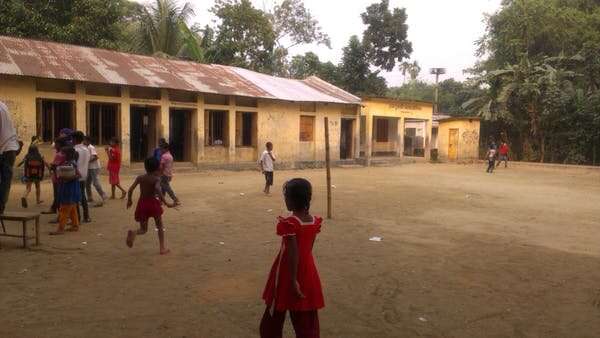
The original schoolground

In Bangladesh the net enrolment rate at primary schools is nearly 100%, but only 32% of the children reach higher secondary level (typically completed at ages 16-18). There are many reasons for this high dropout rate, including poverty and child marriage. 

But one reason that is rarely considered is the quality of the learning environment. Evidence shows many students drop out because they do not feel attracted to school and did not like the traditional teaching and learning environment.

Teaching and learning outdoors has been core to the education system in the Indian subcontinent and was practised widely before the education system was formalised. It is still being practised in the town of Shantiniketan, India, established by the Nobel Laureate poet and philanthropist Rabindranath Tagore. But the idea is not mainstream and the political, physical and social infrastructure to support its wider implementation is absent.

I looked into whether learning in an outdoor environment can improve children’s academic attainment, motivation and play in a Bangladeshi primary school as part of my Ph.D.. School grounds in Bangladesh are largely barren fields without any features. Clearly this needed to change if outdoor learning was to be encouraged. The school I worked with was a primary school 80 kilometre from the capital city Dhaka. 

I wanted the children’s input for the redesign. I asked Grade IV children (eight- to 12-year-olds) what they would like to have in their playground for both learning and play. The children drew pictures and shared their thoughts. I brainstormed with teachers separately and asked what they would need in the outdoor learning environment in order to take curricular teaching and learning outdoors.

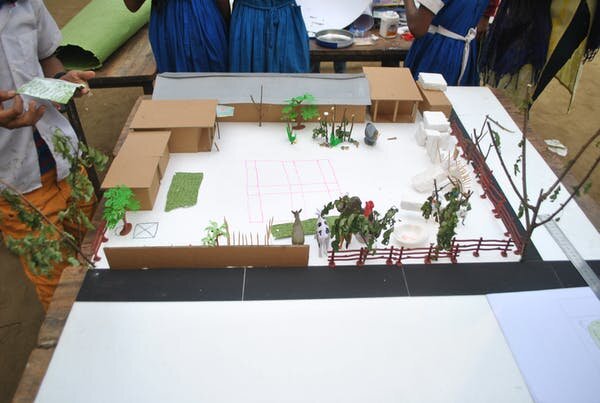
Then we all participated in a model making workshop, led by the children. I supplied materials based on the drawings made by children and suggestions offered by teachers. We have presented the model to the local community who came forward to help us with whatever resources they could offer.


The model.

A new classroom

The children wanted places to explore and experiment, to play and learn together, to challenge them physically and intellectually, to make things and be creative, to connect with nature, to be alone and to reflect. Studies with children from different parts of the world have yielded similar results, showing these preferences are universal.

Teachers, meanwhile, told me that nature can offer opportunities to try out science. They wanted different types of vegetation and a garden in the schoolyard. They requested an area with different loose materials such as twigs, branches, seeds and egg crates to help them demonstrate number theories and other mathematical problems. They also asked for some group learning settings for group activities and an outdoor classroom.

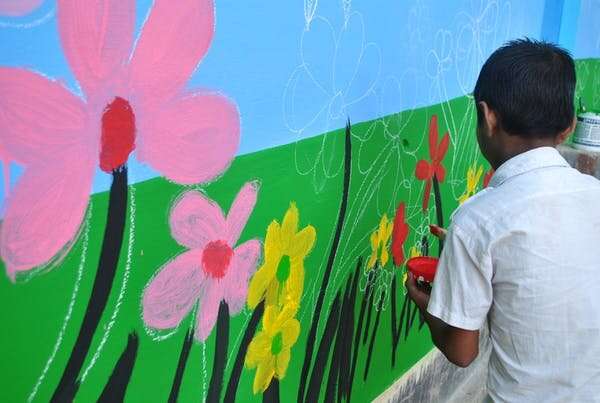
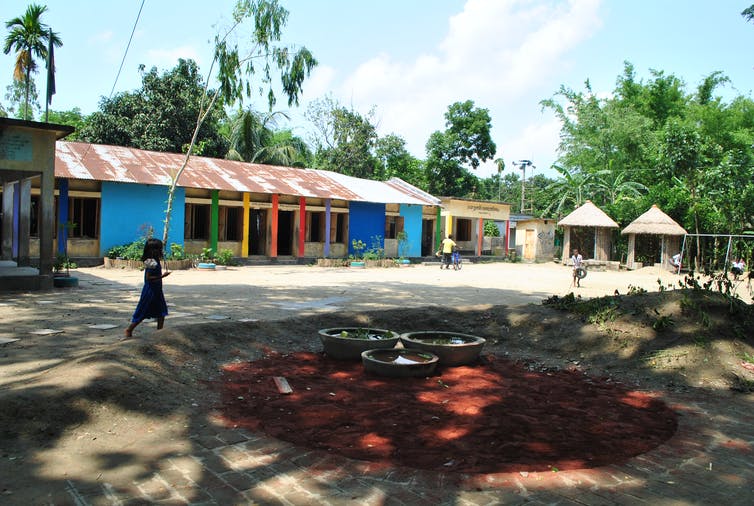
All of these preferences were then taken into account when the Bangladeshi architect, Fuad Abdul Quaium, and myself designed the school ground. We hired local masons and used low-cost materials and technology. The children designed a mural. The school ground was ready for use in January 2015. The teachers led children outdoors regularly for their maths and science lessons.

My research showed that the children’s attainment in maths and science improved after teaching and learning outdoors. The Grade IV children performed significantly better in maths and science compared to a comparable school which had had no change in the environment. 

Hands-on learning outdoors made learning fun and engaging for everyone, but particularly benefited underachievers. We found that children who didn’t interact much in the classroom setting were more pro-active and participated more in their outdoor sessions.

The mural
The new school ground

An outdoor future

Outdoor classrooms can also provide the space to maintain social distancing while learning. But the school ground should be designed in a way to support teaching and learning, and teachers need training in use of their school ground and surroundings for teaching. My research strengthens the already existing evidence on benefits of outdoor learning. The study also generates new evidence for its use outside western countries, suggesting outdoor learning has the potential to improve the quality of education all over the world.

Design a site like this with WordPress.com
Get started