Giovanni Bosco (1815-1888) was born into a humble Piedmontese family and raised in the Catholic faith, becoming a priest in 1841. He dedicated himself to the education of street children and founded the Salesian Order, named after St Francis de Sales.
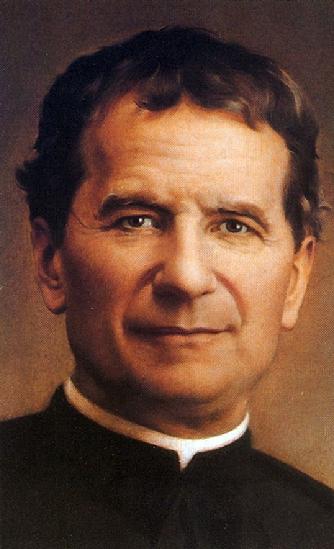
He promoted the Salesian Preventative System of education, in contrast to what he called “The Repressive System of Education”. His approach was based on three “pillars”, “reason, religion and loving kindness”.
In a letter to one of his former pupils Don Bosco defended his pedagogy based on love.
Aren’t the boys loved enough? You know that I love them. You know what I have put up with for a good forty years and what I still have to endure now. What tiredness, humiliation, opposition and persecution to give them food, a home, teachers and moreover to ensure that their souls are safe. I did everything that I could and that I knew for them; they are the love of my life.
I am not talking about you.
And now, who is going to take over, managers, prefects, teachers or assistants? You can’t see that they are martyrs of studying and working. Who will use their young years in the service of those that divine Providence entrusts them with.
I see, I know, but it is not enough, it’s lacking the best.
What now?
It’s not only that the boys are loved, but they know that they are loved.
Don’t they have eyes in their heads? Don’t they know it? Don’t they understand that I do everything just for them.
No, I repeat. It isn’t enough.
What do we want then?
That they are loved should please them, that one adapts to their tastes as young boys and that that they discover love in things that don’t really please them, such as discipline, studying, personal mortification and that they learn to do them with spirit and love.
The actual cause of the changes to the chapel is the lack of confidence in their superiors by a number of boys. Once their hearts were wide open to them, the children loved them and obeyed them immediately. Now, the superiors are considered as superiors and not like fathers, brothers or friends. They are feared and little loved.
I must demolish the fatal barrier of mistrust and substitute a mutual confidence, so that obedience guides the pupil like a mother leads here child; so that the former peace and joy will again reign in the chapel.
How can we break that barrier?
Familiarity with the youngsters, particularly through recreation. Without familiarity, the affection does not prove itself and without that proof there won’t be any confidence.
Anyone who wants to be loved must show that they love. Jesus made himself small among the children and carries our weaknesses.
The teacher who only sits at his desk is a teacher only in name, but if he joins in their games he becomes like a brother”.
(10 May 1884)
“Two methods have always been used in youngster’s education; the repressive method makes the subordinates know the law, monitoring them to find the delinquents and administering whatever punishment is appropriate. Wherever it is applied the attitude and speech of the superiors has to be constantly severe and menacing, they have to avoid any familiarity with their inferiors. …. That method is easy and less tiring, it is suitable for the Army and for sensible adults who know and remember how to conform to the law and other regulations.
Very different is the preventative method, which teaches the institution’s rules and regulations under the attentive watch of the teachers, who talk like an affectionate father, their guide in every circumstance, dispensing advice and correcting their deviations with kindness. This approach makes it impossible for the pupils to break the rules.
This way should be preferred for the following reasons:
- Pupils prevented from deviating will not become demoralised because of the infractions committed
- Children often briefly forget the regulations and the associated punishment.
- Repressive methods may prevent disorder, but they rarely correct the delinquents.
The Valdocco Association
The organisers encourage the children’s activities in this building in the Parisian suburb of Argenteuil whilst the parents look on. In the heritage of Don Bosco, this enables them to come into contact with the pupils.
In his words, “Don’t delay in busying your self with the youngsters, because they won’t delay keeping you busy”.
Jean-Marie Petitclerc, the association’s director, says, “His pedagogy commenced in a time of crisis for Italy as it passed from a rural society to an industrial one, from a monarchy to a republic. That was accompanied by a crisis in the transmission of values and by considerable turbulence amongst youngsters.
We are also in crisis; when everything becomes unclear, when institutions become weak the important thing is the personal relationships with the youth. This relationship develops in the street or this suburb. This is the time for the educator to appreciate the youngsters’ world and his history.
Once that hurdle is overcome, the objective is to gradually integrate the youngster in an educational process. This overcomes the fatal barrier of mistrust between them and adults.
Outings, camps and workshops make sure that they are hooked.
We are so involved in living together that we lean on the knowledge of the children and the adolescents. These youngsters have such qualities, audacity, courage, an ability to surpass themselves, for example.
The relationship may also be a scholastic one, aiming to prepare the individual for a profession. One of the strengths of Valdocco is its “global approach”. We look at the child in every dimension, the street, the school, family; you cannot separate them. Nowadays, there is generally too much compartmentalisation. The association is true to Don Bosco’s heritage by progressing along the three ways in a coordinated manner.
A child participates in street activities in front of his home, then moves on to more structured activities. Soon enough he will be lead into benefiting from scholastic accompaniment in the evening. For example, at the Champagne site, there are two ground-floor rooms where they can start.
As opposed to the street activities, scholastic support implies enrolment and contact with the family. In some cases this may cause difficulties between the child and parents. In those situations we mediate between them. If there is a need for external support or detachment, then the system of child protection is involved, this is very complicated in France, we liaise between them.
One of our key ideas is to create links between all the adults involved in the child’s life. We work with other local associations to smooth the child’s course.
We apply Don Bosco’s principle, “Without affection there is no confidence. Without confidence there can be no education”. We try to build a relations with the adolescent based on friendship. We also has to develop the youngster’s self confidence as well as their confidence in the adult. For the educators to be credible they have to live in the same area as the youngsters and their behaviour must fit in with what say and do. The Association thinks that state schools may be inspired by Don Bosco’s pedagogy because it is appropriate for a system with great difficulties and it shows how we can live together. We have been working with some state schools for some time. With their disturbed pupils we have a 50-50 success rate.
 Jam Butty's Alternative Education