The Middle Schools rebel
This is my translation of an article in the Spanish newspaper, El Pais, which is similar in outlook to The Guardian. My comments are at the end.
Madrid / Pontevedra 21 JUN 2017 – 15:34 CEST
The number of alternative education schools in Spain is increasing
The district of La Ventilla, in Madrid, is a hidden and rather isolated area of poverty.
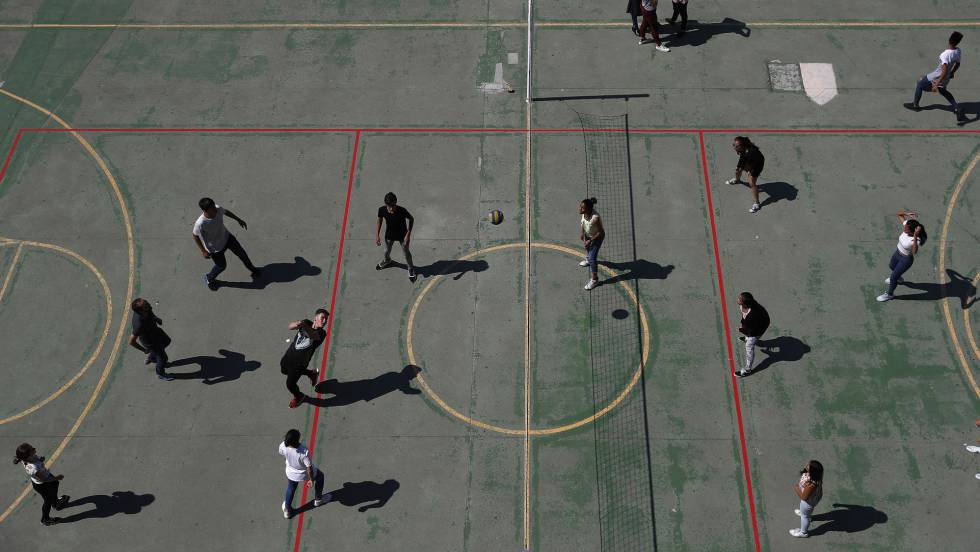
If it excites me, I learn.
Today it is a humble, working-class district, which is overlooked by four tower blocks; four skyscrapers that loom over the tiny dilapidated houses with washing hanging on the line. In the district’s heart, with its playground at the foot of the skyscrapers, sits Centro de Formación Padre Piquer, middle school. It seems like another neighbourhood school, but it isn’t.
From Madrid to Vilanova de Arousa, on the Pontevedra coast, it is quite a jump to reach CEIP Viñagrande-Deiro, which again appears nothing special externally.
Both Padre Piquer y Viñagrande are two of the increasing number of schools in Spain that give an alternative education. Fixed classroom, subjects and textbooks belong to the past in these schools.
In these schools there are no subjects or textbooks. Teachers and pupils move between rooms and different ages mingle.
“Here we work in topics, not subjects”, explains Ángel Serrano, head of Padre Piquer, a charter school run by Fundación Montemadrid, which welcomes pupils from 12 years old and specialises in the socio-linguistic and maths-science spheres. “We don’t have subjects or textbooks, we use digital material, working in large groups of 60 pupils with three or four teachers. The pupils take the initiative in their projects and the teachers guide them. They have a wide range of freedom and they decide where to go. These methods are used in primary education, but we use them with adolescents.
In Viñagrande, which is a state school, primary education follows the same process. The head is Javier García, who is young and three years ago was on the point of abandoning his career as a teacher. “I came to this school and found demotivated teachers and listless pupils. I had two options, either to leave or to change things from top to bottom”.
He changed them.
Javier and his team tore down walls and partitions to create open spaces. They abandoned textbooks and subjects; primary and secondary pupils worked together.
Teaching materials were organised by context, of which there were four; humanistic, literary, mathematical and scientific.
“The children participate in projects, they don’t follow lessons from a book. In the project, as well as learning the material, they work in different spheres, produce reports, they tweet, interchange ideas…. The difference from what we did in the past is enormous”.
Colexio Viñagrande does not seem like a middle school. The classrooms are large, bright and full of stimuli; books, computers, posters, boards, games, photographs, video cameras, tripods, tablets… The children move around without apparent order or organisation. A shoeless teacher passes along the corridor. “And, nevertheless, they are working”, says Javier. “They are working hard. Each kid is involved in a project and the teacher helps by pointing them in the right direction. They have to complete the project in the same way as they had to learn as lesson previously. It is just that the format is very different”.
In watching the pupils, one sees boys and girls full of energy, keen to complete their projects.
“Making children sit from nine in the morning and imagining that they are listening to you for five hours is absurd”.
For this reason, in Viñagrande, the first thing that the pupils do after arriving is an hour and a half of rhythm. movement and gymnastics. María Castro, the PE teacher, explains using terms such as “synapse, cerebral cortex, hemispheres, basic reflexes, psychomotor….”. What Maria is saying is “a 6 year old child is pure movement. Either we stimulate them or medicate them because of the hyperactivity caused by being seated for six hours in silence.
The new wave
Padre Piquer and Viñagrande use alternative methodologies to those usually employed in the Spanish educational system. They comply with the law and are inspected regularly. The results are satisfactory, the pupils emerge educated.
Carmen Pellicer, president Trilema Foundation, defines wide-ranging concept of alternative pedagogy as, “Doing things in a flexible way. Find out what motivates the pupils and work with that.”
Dr Eulàlia Torras, lecturer at Valencia International University, adds that, “The design of this type of education is not contrary to that of traditional education. On the contrary, it is based on models from Educational Sciences that have been used for many years. Its innovation is the emphasis upon information technology and electronic communication.
Establishments using alternative methods show lower rates of absenteeism and dropout. There are different schools or methods; the majority of which were developed early in the last century. One which has been successful is the Waldorf school, where the pupil’s self-development is the primary objective. There are no subjects or books and the pupils do not learn to read or write until they are seven years old, instead they use the time to play and develop themselves.
Montessori pedagogy, of Italian origin, gives the child freedom and the teacher is turned into an observer. The Regio Emilia method, also Italian, is based on real experiences; whilst the Changemaker system looks towards social transformation through creativity. There are many more methods including Doman, Kumon, Amara Berri… All are characterised by being different from traditional methods, giving greater autonomy and freedom to the pupil.
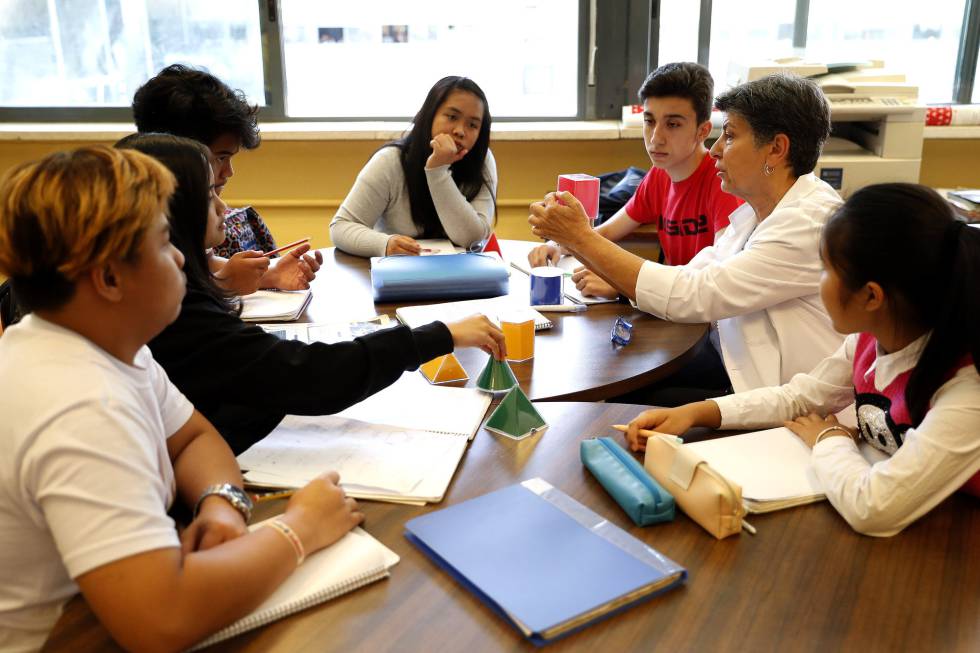
Pupils recently arrived in Spain learn Spanish.
Eulàlia Torras explains that, basically, the methods belong to three groups: behaviourism, cognitivism and constructivism. Constructivism is found in many of the educational models.
“We aren’t hippies”.
“There are parents who believe that we are hippies here. And you have already said that we are”, said Javier laughingly, in the entrance to Viñagrande. “One thing is that the pupils has more freedom here and another is doing what they want. No. We are constantly observing, supervising and attending to them, so they perform to the maximum”.
“Some parents do believe that we are hippies. It is normal to be distrustful, but the results are there to see”.
In fact, evaluation in Viñagrande is more rigorous that traditional schools. We grade them daily, evaluating how their projects are developing and recording it every day. What happens is that we focus on the positive, the things that they do well and we try to develop those. We report to the parents, always starting with what they are good at, so the parents will then stimulate them.
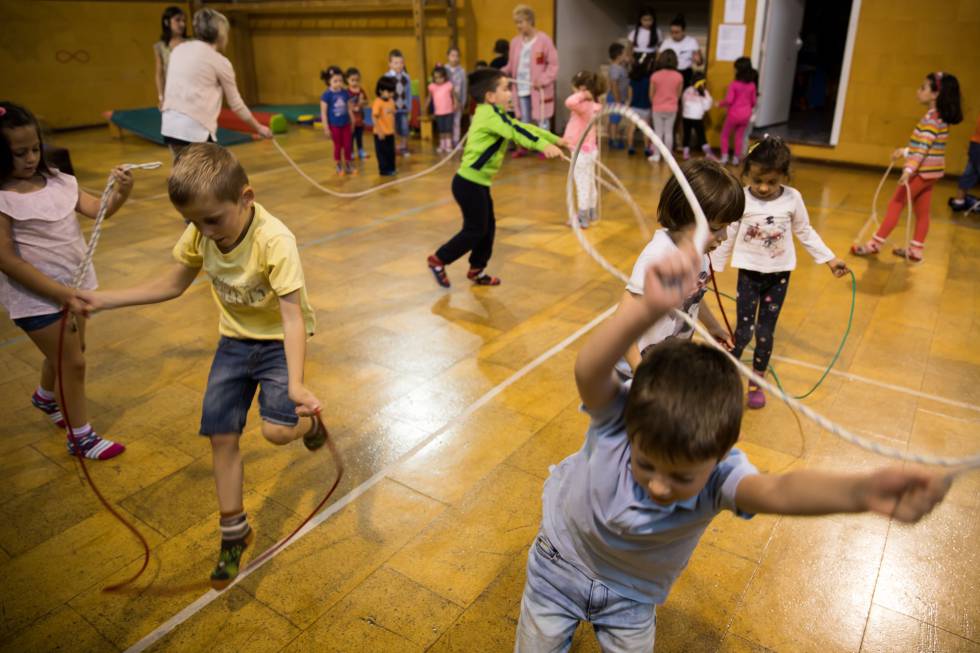
Physical Education Class in Colexio Viñagrande de Vilanova de Arousa. ÓSCAR CORRAL
Colexio Viñagrande does not seem like a middle school. The classrooms are large, bright and full of stimuli; books, computers, posters, boards, games, photographs, video cameras, tripods, tablets… The children move around without apparent order or organisation. A shoeless teacher passes along the corridor. “And, nevertheless, they are working”, says Javier. “They are working hard. Each kid is involved in a project, the teacher helps by pointing them in the right direction. They have to complete the project in the same way as they had to learn as lesson previously. It is just that the format is very different”.
In watching the pupils, one sees boys and girls full of energy, keen to complete their projects.
“Making children sit from nine in the morning and imagining that they are listening to you for five hours is absurd”.
For this reason, in Viñagrande, the first thing that the pupils do after arriving is an hour and a half of rhythm. movement and gymnastics. María Castro, the PE teacher, explains using terms such as “synapse, cerebral cortex, hemispheres, basic reflexes, psychomotor….”. What Maria is saying is “a 6 year old child is pure movement. Either we stimulate them or medicate them because of the hyperactivity caused by being seated for six hours in silence.
The new wave
Padre Piquer and Viñagrande use alternative methodologies to those usually employed in the Spanish educational system. They comply with the law and are inspected regularly. The result is the same, the pupils emerge educated.
Carmen Pellicer, president Trilema Foundation, defines wide-ranging concept of alternative pedagogy as, “Doing things in a flexible way. Find out what motivates the pupils and work with that.”
Dr Eulàlia Torras, lecturer at Valencia International University, adds that, “The design of this type of education is not contrary to that of traditional education. On the contrary, it is based on models from Educational Sciences that have been used for many years. Its innovation is the emphasis upon information technology and electronic communication.
Padre Piquer classroom, recently arrived immigrants learn Spanish.
LUIS SEVILLANO ARRIBAS
Padre Piquer also met with distrust from some families when it adopted its new methodology in 2003. Mónica Díaz-Masa is the co-ordinator of the Co-operative Multitask Classroom. “Since we implemented this approach, only two families have removed their children. Normally the families who distrust this system are those with children who gain very high marks, they fear that the school will worsen their results.
Nevertheless, the data from Padre Piquer is clear, 85% success (graduate) and only 0,7% absenteeism, one of the lowest in Spain. This from a school of 1,100 pupils, of which 77% receive financial support. That is to say most come from the middle and lower classes with the associated risk of dropping out.
In addition, there are children of 34 nationalities and eight religions. A social mosaic which, to the surprise of many, functions well.
“After three months we had already noted a huge change”, said Ángel. “As well as explaining how the system works to the parents who showed doubt, we showed them the data, which is unanswerable”.
Beyond the distrust and opinions, there is the Law. All schools in Spain must conform to the educational system, which is effected both by central government and the autonomous regional ones.
This obliges the school to cover basic areas, such as linguistic communication, mathematics, science, civics, etc. As long as these are covered, the law is flexible as to how they are taught.
Both Padre Piquer and Viñagrande, like all schools in Spain, are inspected regularly and are accountable to their respective ministry.
“They see that our system works and they have no reason to create obstacles for us. The administration is favourable towards our developments”, explains Javier García.
“In the same way that we don’t want the medical system of 40 years ago for our children, the parents should not want that model of education for them”.
Evolution is inevitable. The system of two decades ago will not work with the children of the 21st Century.
“Many parents imagine that their children’s education is just like theirs was. Just as medicine today is very different to 40 years ago, so too is the educational system. The systems of our parents are not appropriate for the children of today”, explains Carmen Pellicer. “The schools with innovative methods are those that have lower rates of absenteeism and failure. This indicates that it works.
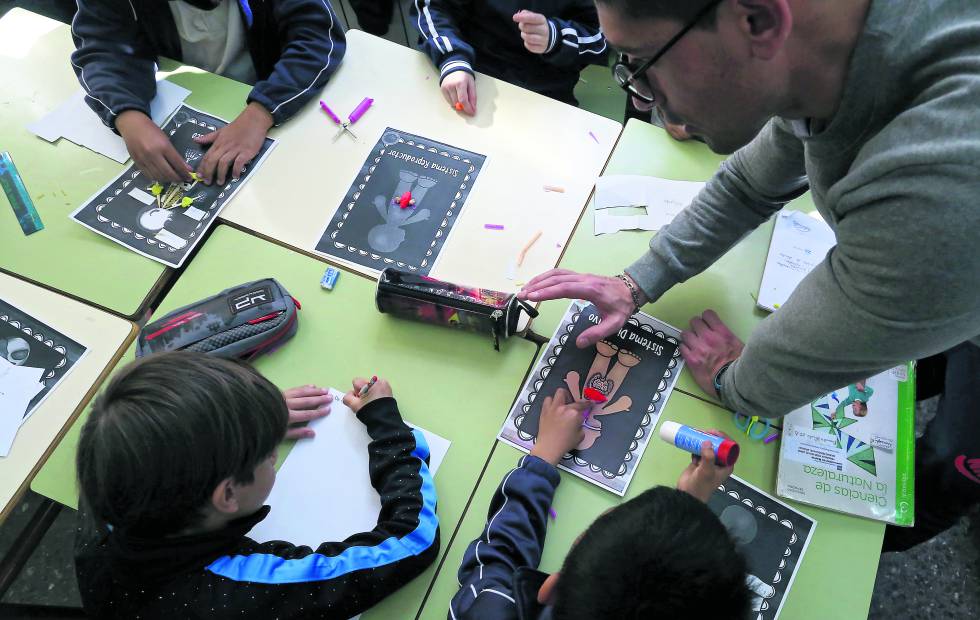
Immagination applied to studying
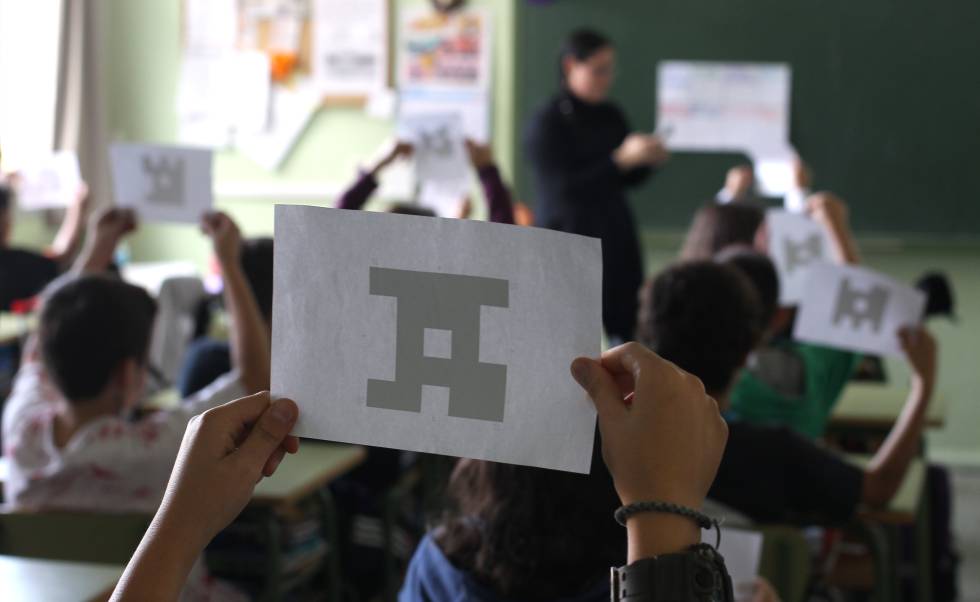
Learning through projects is revolutionising schools.
This article reminds me of teaching in a new comprehensive school in the West Riding of Yorkshire from 1975 onwards.
Sir Alex Clegg, the far-sighted Chief Education Officer of the West Riding, supported the kind of methods outlined above and our building was partly designed to promote them with classrooms clustered around shared areas. The Craft, Design, Technology wing was more open plan.
The project approach never really took off for a variety of reasons, including a Head who wasn’t committed to it, many teachers likewise; the main focus was on examinations with the pupils in “sets” after Year 9.
We were fortunate in Science that there was the Certificate of Secondary Education (CSE) for 60% pupils who weren’t entered for the General Certificate of Education (GCE). The top CSE grade was equivalent to a GCE Pass.
There were 3 modes of “examination” for CSE.
Mode 1 – GCE type examination.
Mode 2 – GCE type examination + project
Mode 3 – Project
We opted for Mode 3, encouraging pupils to do some scientific research.
On the basis of a standardisation meeting teachers were paired, so lenient markers were paired with severe ones, and so on. The pair then graded each other’s pupils projects.
I found these meetings to be the most fruitful part of the process. One saw how other teachers approached topics and which strategies were particularly fruitful.
Most importantly, some of the projects were really incredible.
This started to grind to a halt when GCE and CSE exams were amalgamated into the 16+ exam, which covered the full range of “abilities”. This did involve some project work, but on a much more restrictive basis than Mode 3.
Kenneth Bakers 1988 Education Act, which introduced the National Curriculum marked its death knell. Michael Goves’ reforms putting the final nail in project works coffin.
 Jam Butty's Alternative Education