Born in Wales; in 1800 Robert Owen became the proprietor of the Scottish weaving mill of New Lanark, where he improved the workers’ conditions. His factory rapidly became a model, thanks to its innovative educational structures, like the children’s garden and the evening classes.
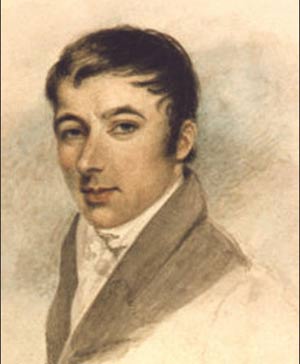
For all that he was unable to convince English mill owners to apply them on a national scale.
After three years in the United States, on his return in 1827 he failed to put into place a network of cooperatives and trade union centres. He presented his doctrine in “The Book of the New Moral World” and today he remains as one of the representatives of “utopian socialism”.
Learning to be happy together.
In order to educate his employees children he created a laboratory-school in 1816 which held 759 pupils from 3 to 25 years of age.
Robert Owen avoided traditional methods and selected teachers who knew how to awaken the children’s curiosity.
“Since that time, I have gained the real affection of all the children and I mean all of them because every child above the age of one is sent to school. I have won the hearts of all their parents, who are impressed by the better behaviour, the extraordinary progress and increasing happiness of their children.
Using teachers who are habituated in the old bookish system of teaching would be in vain, I have resorted to two people who have plenty of affection for children and unlimited patience, are willing and able to follow my instructions without reserve. The best that I could find in the village, in that regard, seemed to be a poor honest weaver called James Buchanan, who with his wife had devoted his life to the dying craft of hand-weaving ordinary cotton fabric. He loved children passionately and his patience was inexhaustible.
For the very youngest children I found Molly Young, a young woman of 17 years, who through her intelligence can help her companion to learn something that is completely new to both of them.
The first instruction that I gave them was that under no circumstances should they hit a child, nor threaten them with any words or gestures, nor use menacing language; but they should talk to them in a pleasant and amiable manner. They must tell the children, both young and old, that they should do everything to make their playmates happy and, that the older ones had to look after the younger ones. They had to help them to learn in order to make them happy too.
The classroom is decorated with paintings, mainly representing animals, but also maps. There are often items from gardens, fields and woods to be examined and explained to excite curiosity and provoke animated conversations between the children and their teachers, who acquire knowledge about trying to instruct their young friends, which is how I always recommend them to consider and to treat their pupils.
The opinion that has prevailed for a long time recommends that work and interests should be meticulously separated. It appears that this meticulously separation is a synonym of poverty, ignorance, of all sorts of waste, of a general antagonism towards society, of crime, misery and both physical and mental weakness.
In order to avoid these ills, mainly because they will perpetuate themselves, keeping people in a state of perfect servitude; each child needs an early general education that will adapt them to the proper ends of society, permitting them to be useful and to live contentedly.
Under the age of 12 years one can readily lead them to acquire a view of the knowledge at which Man has arrived.
Early in life, they will thus understand this relates to past centuries, to the times in which one lives, the environment that one lives in, the individuals around you and coming events. It is only in this way that one can claim the title of a rational being”.
Analysis – Thierry Paquot
Thierry Paquot is a philosopher and professor emeritus at IUP (Institut d’urbanisme de Paris).
The Utopian School
Utopia isn’t grey, sad, uniform, fixed, egalitarian or authoritarian; it can be pluralist, innovative and liberating.
In 1816 Robert Owen’s named his school at New Lanark the “Institute for the Formation of Character”.
The pupils’ day consisted of seven hours of sleep, half an hour of religious education according to the parents’ belief, six hours of recreation, which consisted of dancing, music and military drills; and ten hours of courses and workshops.
Owen said “We must be careful not to teach the children anything that they would later be forced to unlearn, the most difficult thing in the world”.
The teachers had to be the best; educated, open, available, gentle and indulgent. They learned to learn.
He was sure that education liberated the individual from the constraints that social life and work conditions imposed. Without culture, a worker remains vulnerable. Knowing how to read and write he can discover his rights, forge an opinion, debate with his fellow workers, denounce abuses and suggest reforms. In brief, because he has his destiny in his hands, he can construct it for himself.
He was sure that school was a “character factory”, modelling the child and allowing him to become “good”.
To understand the why and wherefore of education it is necessary to start with John Locke’s “Some Thoughts Concerning Education” (1693) and to progress through Helvetius, Voltaire, Rousseau, Diderot, Wolff,ô Basedow and many others who defended the role of the State and a body of professional teachers with individualised curriculums and personalised monitoring; these were the utopists of the 18th and 19th Centuries. They insisted that the individual was perfectible with the ability to attain happiness through the careful application of the science and technology that, too often crushed them rather than improving their lot.
The methods, curriculum, timetables; child-parent, teacher-pupil, boy-girl relations; the manual and intellectual activities varied from one author to another, but they all start with plans for an ideal education, with or without a school or the family.
Henri de Saint-Simon said, “It may be considered as being the continuous teaching of knowledge that is indispensable for effective relations between the members of society”.
Charles Fourier, the most radical and original of the utopian thinkers based his ideas on “passionate interests” with a system that judiciously accentuated the various interests that each person possessed. From a delicate and sophisticated system, it is worth repeating some lines from “The New Industrial World and Society” (1829) – “With food, the child must actively exercise two senses, taste and smell; at the Opera, two passive senses, vision and hearing are employed; and the sense of touch in needed for the work at which the individual excels”.
Each child teaches and is taught, interaction and responsibility are permanently mobilised allowing each one to be themselves.
Etienne Cabet, in “Icarus” (1839) notes “Next, education is everything or almost everything and without it Man is nothing or almost nothing”.
Up to 5 years of age children play together and explore their surroundings, the gardens, houses watched by one or more of the mothers. In that “school without walls” there is a “domestic education” and the child learns to read from its mother, also to write and recite.
Then in school, with pupils from 5 to 18 years, from 9am to 6pm, they receive a varied and interesting education without early specialisation.
Self discipline is preferable to discipline, as is the joy of learning to obligation.
Andre Godin, an industrialist and utopian built his “Familistere” at Guise (Aisne) in 1859. the lessons were interspersed with visits to the factory and workers’ gardens. Self evaluation was encouraged, as was “modern” mathematics, design and use of pictorial material; in effect, cutting edge pedagogical methods and materials in a school that was not only concerned with work-related training, but also had a social conscience.
All the utopian schools had more or less detailed components (Edward Bellamy, William Morris, Theodore Herzel, Jean Grave, Emile Masson, Aldous Huxley, Ernest Callenbach, etc) where the child would be “collectivised” or in a family that wouldn’t just prepare it for a job, but would take into account the preference for the Arts or Sciences whilst being attentive to a shared foundation of knowledge.
The child was treated as a human being in their own right, with a sexuality, desires, rights and duties; not as the word “infant” – “not speaking” implies or “a little man or woman”, but as a whole person.
This idea did not escape Thomas More (1477-1535) the founder of utopian literature. In “Utopia” (1516) he denounced the unfair political situation in England and presented an ideal society, where the children from the earliest age worked in the fields.
“Thanks to the teaching received in school, thanks also to the recreational activities in the fields around the town, where the children will not be content to just observe, but also to work in order to obtain physical exercise”.
On that island sheltered from the World, which appears on no map, everything is devoted to developing oneself, whilst making sure that no one is forgotten on the road to understanding. According to his biographers and his friend Erasmus, he offered his daughters a wide education, including Greek, Latin, philosophy, theology, history and geography… singing and music, drawing and eloquence.
 Jam Butty's Alternative Education