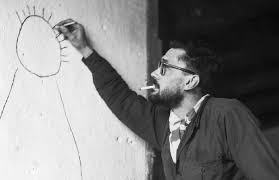
Deligny was born at Bergues (Nord), he was a specialist primary teacher, then an educator who opposed the teaching methods of the Vichy Government. From 1947 to 1962 he was Head of “Le Grande Cordèe” which attempted to rehabilitate young offenders. This was supported by movements for popular education.
In 1968 he founded a centre in the Cèvennes for autistic children.
He is the author of some memorable publications, including “The camera, a teaching tool” and the coauthor of films made with autistic children.
He was the poet pedagogue who wanted to help the delinquents, the homeless and the psychotic, not to love them.
When the law changed in 1945, the activities of Fernand Deligny were an act of pedagogical resistance. His “poetic pedagogy” is unclassifiable, indefinable and unrecoverable.
Deligny was a teacher, educator, writer, film maker and a militant. He was influenced by the philosophy of Gilles Deleuze and Felix Guattari, he moved the boundaries, shook the framework and subverted the constraints of the established order. The way he helped the lower class children to teach themselves, the homeless to escape from their problem, the autistic to find dignity outside closed centres and create art works is now largely ignored.
Everything started at the lunatic asylum in Armentieres, situated between Lille and Bergues, where he was born. There, he discovered the problems and life of the mentally incapacitated. He was a specialist teacher greatly influenced by Freinet’s approach. He found himself as the main teacher in what was effectively a dumping ground for hundreds of abnormal children, who awaited their return to normal life.
In “Pavilion 3” (1944), he wrote about his fascinating experiences in this world where they concentrated on the loss of reason suffered by the survivors and human wreckage of the Second World War.
Deligny was not opposed to psychiatry, but searched for other ways to deal with these problems.
In this grey barracks of a building, he pushed the hierarchy to ban arbitrary punishment. In “Belief and Fear” (1978) he recalled, “I loved the asylum. Take my words as you will, but I loved it because it was strong, just like most people love someone with whom they decide to spend their life”.
“The speech marks that one puts around the word “educator” are like a pair of forceps. I don’t want to educate anyone. My intention is to create favourable circumstances for them to survive and live”.
After the war, when his name was already well known, he resisted the politics of safeguarding children introduced by the Vichy Government, so when the 1945 law recommended the re-education and protection of delinquent children, the phrases of his book “Delinquents’ Potential” were widely echoed amongst social workers.
His outlook was Marxist and Libertarian opposing, “A nation which tolerates slums, open sewers, overpopulated classes and dares to punish young delinquents.
With the aid of the psychobiologist Henri Wallon, who was a member of the Communist Party, and from popular education movements, he founded La Grande Cordèe, an association to take care of and cure delinquent and disturbed children. This enterprise to reinsert them into society was more of a network of placements for those with lost childhoods than a centre.
Deligny was never content just to save them, he never stopped searching for new ways to help them. He wasn’t an Abbé Pierre of the playground, nor a Don Bosco of social centres, “All effort not supported by research and rebellion soon becomes stagnant. What we want for these kids is for them to learn to live, not to die. To help them, not to love them” (“The Effective Vagabonds 1947).
In spite of everything, Deligny struggled with difficulties regarding support and finance and he found himself in the wake of these problems.
“The children have ears” (1948) , a series of stories where people are bundles, or an old slipper or a wooden bench, shows how a story imagined together can make things come alive and creates a state of emotional collaboration with children with whom direct exposure to friendship and camaraderie may frighten them away.
This dream marked Deligny’s brief affinity with modern progressive education. He usually kept his distance from, what Jean-Francois Moreau calls, “The ideologies of childhood”. That is those humanistic concepts of the child which result in the shaming of adults and parents. Beside which Deligny had no pedagogy, his was an active practice that evaded the institutional constraints. Later he was saddened by the changes in popular education that emptied it of its political and poetic power.
He explored the camera, which was then a new educational tool. Faced with the images that invade the screen and the spirit, he discovered the film as a language; an idea that pervaded his writings. Rather than creating cinema-goers, he allowed those misfits to use the camera in order to rediscover and form their lives, whilst discovering the world around them.
He produced the film “The Slightest Movement” with Jean-Pierre Daniel, the director of the Alhambra in Marseille, a national artistic and cultural centre. This was to test what could be done with such a cinematic concept. He was part of the adventure with a group of children on the île de Porquerolles. One of them discovered a cork oak and developed a bug for that “soft tree”. Deligny and Daniel filmed that child’s affectionate relationship with the tree.
After some years of wandering, Deligny and his team settled in the Cevennes, where they created an alternative centre for autistic children. In “A young Pasolini and a St Francis” they explore the limits of being human. They recorded the droning and slightest gesture of Yves, a young psychotic sent by a communist group. Yves is a singular figure amongst these isolated beings.
The film is like a poetic western when suddenly two fugitives escape from an asylum. It captures the body language of the adolescents along the tracks of the Cevennes in a moving way. At the 1971 Cannes Film Festival, the cinema was full, by the end of the ten hours only one astounded critic, Alain Cavalier, remained.
Michel Foucault wrote in support of the insane and prisoners, “In this film one is put in the position of the kid. These confused innocent voices sing more clearly than any others. It is enough that they exist and that everything is against them, trying desperately to silence them”.
Many intellectuals of that generation explored the margins of society to find the key to subversion and revolution, so they could move towards redemption. Deligny went further in “Unbearable, incurable, unsupportable” he filmed Janmari, a mute autistic boy. Then in 1975 Renaud Victor created “That kid, there”. There was a discourse regarding the way in which psychiatry looked at children like Janmari. He was wary of the way that psychoanalysis made out that the subject was ill with its analytical grids, he was circumspect regarding the “ideologies of childhood” that made the child an all powerful mini-king or a victim. He tried to “accompany them”, not to “treat them”.
On the fringe of the 1968 disturbances, Deligny, like a general who had taken to the Maquis, was in Graniers, a hamlet in the Cevennes. He asked his troops to ensure the continuity of the route that the psychotics had undertaken. The educators traced the delirious wanderings of the mentally disturbed children in Indian ink on maps. Faced with the total absence of any feeling of otherness that seemed to characterise Janmari, the only recourse seemed to be with him.
These ideas had success; Janmari’s “lines of wandering” crossed the tracks of other individuals in the community. This silent child approached them and started to make hay or bread. Deligny didn’t seek to return Janmari and his companions to normality, unlike the teacher in Francois Truffaut’s film “Wild Child”. In his new network, his “raft”, he never created organised situations. Jean-Pierre Daniel declared, “It is through work that education is established”.
Certainly, Deligny, an educator outside the norm, doesn’t offer any pedagogical recipes. Unlike Montessori, there isn’t a “Deligny Method”, there is simply an experience, a route, some signposts that help to orientate us in the difficult process of education. His writings remain as a compass for that process, his films as an invitation to a committed and conscious dream.
He reminds us that the pedagogue’s fuel is “everyday failure” and invites us to pay attention to the slightest gesture of those considered to be good for nothing. So, it won’t be in vain to look at his humane pedagogy.
Though his work is now largely ignored. We believe that the magnificent and monumental “Works of Fernand Deligny” by Sandra Alvarez de Toledo may remedy that.
 Jam Butty's Alternative Education