Roger Cousinet (1881-1973)
At the beginning of the 20th Century, under the supervision of Emile Durkheim at the Sorbonne, Roger Cousinet prepared a thesis on the social life of infants. In 1910, he became a primary inspector. In 1920, with voluntary teachers, he put into practice his approach of free group work. His educational theories created suspicion in the hierarchy.
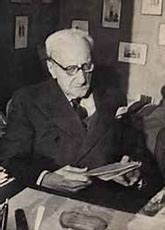
Between 1944 and 1959, he taught pedagogy at the Sorbonne. In 1946, together with Francois Chatelain, he founded the Ecole Nouvelle Francaise at Meudon and the Ecole Nouvelle de La Source, which is still working today.
Roger Cousinet is recognised as the pioneer in France of the New Education.
To Cousinet, infants are not a immature adults, but a specific individuals for whom it is right to develop relationships with their peers.
School should be special place where they can organise their work within a chosen group.
School should be the children’s home, they should furnish it, decorate it and entertain their fantasies there. The following approach is suitable for all their work; they can organise themselves freely into groups, which they can change as they feel the need.
The teacher never obliges a pupil to work in a particular group, nor to leave it or for a group to accept or refuse an individual. Whilst the children are at work, she will not interfere, whatever the work may be. The children are left alone in their task, they are not directed, guided or given any assistance, except when the children ask a question.
If one member seems not to be working, the teacher does not comment, but waits for the moment to arrive when the others push them out, having noticed the poor attitude or the inappropriateness of their ability, be it too high or too low. The individual has to find another group for themselves.
With written work, each group had its own blackboard and when they had finished the teacher would read the work back to them indicating mistakes. She would only correct them when the children showed themselves incapable of correcting it themselves and only explained the corrections if the children asked for an explanation. He considered that the study of grammar should take place in the later years of schooling.
The maintenance of the class largely depends upon the children. Each group has its own place where its collection of minerals, plants, insects can be kept.
The materials consist of a group exercise book in which the group’s work is recorded, a special exercise book, a reading book containing the group’s compositions; stories, accounts, poems and jokes. Part of a wall is available for the display of drawings.
Work begins with each group making a descriptive resume which is partly literary and partly scientific. They complete calculations in that resume, such as the area of the room, its volume, the window area, the size of furniture and the central heating system. They work out prices from tables that they themselves have produced from information coming from shops and regional industries. They identify any repairs that may need to be done. This work, as one can easily see, is rather long term. The children can ask the teacher, whenever necessary, for whatever information they require and they organise the calculations between the groups.
To these tasks, the creation of a map of the classroom, then the school (geographic work) and the organisation of collections (scientific work) can be added.
This approach leads to children to be occupied in work that is may be literary, mathematical, geographical or scientific.
It is no longer necessary to allow this work to develop in the normal direction. The scientific part can be enriched by the development of the groups’ collections, whilst their arithmetic can progress through the calculations that concern the upkeep of the classroom, these tasks may largely be contrived ones. With the class organised as a cooperative and using the accounts from a school shop, the pupils can see real commercial operations and learn to keep simple accounts.
Each group maintains a notebook relating to all the activities that the class has entrusted to it.
The geographical work is widened to the location of the school, the area in which it is located, its immediate surroundings; extending to the study of the region’s weather through daily observations of the wind, rainfall, day length, etc.
History is a voyage into the past; what were the schools, the towns, the clothes or the tools like in past times. Again, the methods used here are observation and analysis. The children are provided with pictures relating to each of these aspects.
In this way, all the disciplines can be presented in a way that connects them in a playful way, in the form of games and tied to their culture. This allows them to live and construct the environment that they need.
I have provided some fairly precise indications that seem to be essential for this technique. However, I have not specified an order or even less a programme. Putting things into an order through mental representation is an indispensable activity in any education worthy of the name.
La Prairie, a safe place for children.
La Prairie in Toulouse is a private school without religious affiliations, its founders were inspired by Roger Cousinet’s ideas. For more than forty years it has endeavoured to develop a love of learning and a sense of responsibility through freely-chosen group activities. It enshrines the idea dear to Roger Cousinet, of making school the children’s home.
On the last Tuesday in May, Jean-Pierre Quayret’s class did a dictation; “Spring prowled in the gloomy winter’s day like a being that felt close, but couldn’t see it”.
The studious atmosphere distinguished it from an ordinary school. After the writing exercise, the pupils, in socks or slippers, exchanged copies. The class with its non-frontal organisation is prepared.
In 1969, a time when progressive ideas abounded, the municipality of Vals, near Toulouse (Haute Garonne) created La Prairie. Since 1946 they had followed the progressive policies developed by Roger Cousinet at the Ecole Nouvelle de La Source (Hautes de Seine). The school’s intake stabilised at around 450 pupils, with 300 primary pupils and 150 middle school students. Like all the educational establishments that subscribed to the progressive movement, special regard was paid to the child, who was considered as a person with their own possibilities and not just as a pupil to be taught.
In Jean-Pierre Quayret’s class, they draw upon some of Cousinet’s materials as they work in groups of four. After the dictation has finished, the pupils correct each other’s work before handing it to the teacher. If a couple cannot agree on a correction, the teacher will then arbitrate.
There are no levels, explains the Head, Nicole Illac, the groups organise themselves, it is the pupils who make the choice. With the students dressed in socks and slippers, deciding how the class runs, this truly seems the “children’s home, a place where they make the rules.
Don’t impose adult logic.
Nanou Badie, now in retirement after many years teaching, remains as one of the project’s custodians. She explains, “There are laws which are not negotiable and apply to everyone; those regarding security, for example. The rules here are proposed and discussed, they are not developed for the children, but by them. The adult retains a veto, but must always justify the decision and must constantly be wary of blocking the youngsters, never constraining them through adult logic.
The youngsters are greatly involved in the functioning of their class and they are in charge of the daily activities. The National Curriculum is followed because the school is financed by the State. Nicole Illac elaborates, “We accommodate it in our own manner, in primary classes we don’t use any textbooks. The children create their own little books and they frequently use the library. They are the effectors of their own apprenticeship, each one works at their own pace. Their research engenders a spontaneous interest. We mustn’t obstruct that desire to learn. At La Prairie, as Cousinet said, “The child doesn’t do what he wants, but wants what he does”.
The children’s learning is based on their experiences in a school where it is rare for the walls not to exhibit their achievements. This morning, after the dictation, Class CM2 has become very lively because Ariel has brought a young sparrow that he found in the road a week ago. This creates the opportunity for the French lesson to become a science one and the production of a piece of writing. With the help of Roland and Maxence, Ariel will write an article for the class magazine.
Each morning begins with twenty minutes of “What’s new”, during which the youngsters recount interesting happenings in their life outside school, like the little sister who did silly things after watching Pirates of the Caribbean.
Even though there are changes inherent in the move from the primary to middle school curriculum, the same principles apply. We never push the truth or established knowledge, but we put them into a position where they discover it, each at their own pace. That may well take more time, but it isn’t time wasted. The pupils develop strategies, acquire methods and know-how that they can reinvest later. Here learning to read takes longer but it’s about reading for understanding, not just deciphering. It is necessary to reassure the parents even though most of them entrust us with their children in full agreement with the cause.
Though La Prairie remains faithful to the principles and theories of Cousinet, over the years its pedagogy has been enriched with the teachings of Celestin Freinet, also by the ideas of Fernand Oury. For Jean-Pierre Quayret this is process of logical evolution, “one can see that the idea of institutional pedagogy naturally continues the approach of Cousinet. My pupils modify the class and their responsibilities through their experiences; each they take responsibility for a task, there is the time-keeper, who indicates that there is just five minutes of the lesson remaining, the cleaning task, the recall task where recalling what has just been done and what has to be done in the next lesson. At the end of each week, we evaluate how well the tasks have been performed.
With the class meetings and the establishment of councils, the children often take the opportunity to speak out. Oral expression makes them accountable and autonomous. Former students indicate that they have the aptitude to take responsibility, they make excellent representatives, we see them at the front of demonstrations. They are better at speaking than writing.
However, we constantly examine our practices.
This attitude of re-establishing principles has allowed the school to successfully continue for more than forty years and every year the school is oversubscribed.
Dominique Ottavi suggests that Cousinet’s particular provision regarding progressive education is that it involves the psychology of the child and the child’s ability to develop relationships with its peers. Before him, we thought about the child, but not about children.
He demonstrated their ability to organise themselves, for example in games. He built his pedagogy on the possibility of the teacher using this spontaneous organisation. This is where the idea of making the school their “home” originated.
It is through the discovery of its location and its past; it is by means of the activities that the child effects its learning in the framework of free work in groups.
She says, “Celestin Freinet was part of the same generation, but there was conflict between them when Freinet had to quit the national educational system. Cousinet did not appreciate Freinet’s desire to develop the child’s capacity to resist any form of oppression in their adult life.
For Cousinet, the child’s oppressor was the adult. Even though an interest in manual work and a pedagogy that was close to modern project work was shared, they differed on other points. Cousinet insisted on the free choice of partners in the work groups, whereas Freinet thought of the class as a whole.
Although Freinet is better known nowadays than Cousinet; though Cousinet didn’t leave a movement, his ideas are more widespread. He remains the thinker who introduced psycho-sociology into education in the 1920s. His influence faded in the 1970s, when the influence of psychoanalysis suppressed alternative approaches.
 Jam Butty's Alternative Education